
DJI Agras T25P, T50, T55, T70P, T100 – spray drone comparison
Published: 20 October 2026
Five models, one question: how many hectares can you cover per day, and what will it cost you? We compare tank sizes, payload and operating requirements of DJI Agras drones from the perspective of a company that flies them in the field.
The DJI Agras range is one of the most widely used series of spray drones – according to DJI, more than 600,000 DJI Agriculture drones are in operation worldwide. The models differ mainly in tank volume, and therefore in hourly output and operating requirements. Below is a comparison from the perspective of a service provider who flies these machines in the field.
Comparison table
| Model | Spray tank | Spreading: hopper / payload | Best suited to |
|---|---|---|---|
| T25P | 20 l | 30 l / 25 kg | small farms, orchards, greenhouses, difficult terrain |
| T50 | 40 l | 75 l / 50 kg | farms of 100–500 ha, service providers |
| T55 (new for 2026) | 50 l | 80 l / 55 kg | contractors, orchards and larger fields; cargo lifting up to 40 kg; one-person operation |
| T70P | approx. 70 l | 100 l / 70 kg | service providers, grower groups |
| T100 | approx. 100 l | 150 l / 100 kg | very large areas, cover crop sowing, fertiliser spreading |
Data according to DJI, as at 15 October 2026. Availability and prices in South Africa – on request.
The new DJI Agras T55 – what does it change?
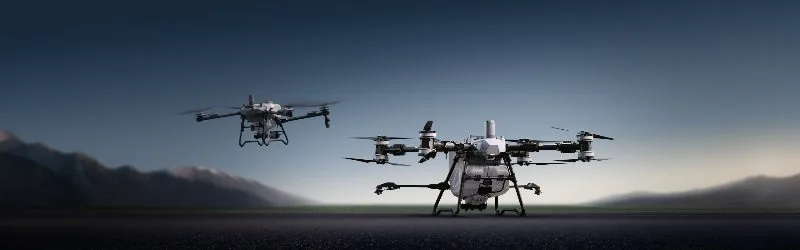
Global launch on 1 July 2026. The T55 is a compact drone with a 50 l tank (about 45 kg including the battery), designed for one-person operation: 50 l for spraying (up to 50 l/min with mist nozzles) and 55 kg for spreading (up to 400 kg/min). It features a cargo lifting system for loads of up to 40 kg and a new millimetre-wave radar producing a point cloud of up to 250,000 points per second. Folded, it measures 1120 × 896 × 934 mm, so one person can load it into a vehicle. In our view, it is the natural successor to the T50 for service providers who want a higher payload without the logistics of the T70P/T100.
Alongside the T55, DJI also launched the T100 Dual Battery – a dual-battery version: up to 50% longer hover time at the same load, but the working payload for spraying drops to 90 kg.
Coming soon: DJI T200 and FlyCart 200
In April 2026, DJI unveiled in China the agricultural T200 and the transport FlyCart 200 – up to 200 kg of payload per drone, and the T200 paired with a second drone up to 360 kg. The launch date for Europe and other markets is not yet known. Would you like to be on the interest list? Contact us.
Bigger tank = higher output?
Not always. Output is also limited by battery charging, water logistics and field shape. On fields of up to 20 ha with many obstacles, in our experience a T50 often covers as many hectares per day as a T100, while being cheaper to buy and easier to transport.
Take-off weight and regulations
All of these drones exceed a take-off weight of 25 kg. Their operation is governed by the applicable SACAA RPAS rules, and the pilot needs the appropriate authorisation and training on an agricultural drone with an instructor. Spray application must also be in line with the product label (Act 36 registration). More on this in our article on authorisations for operating an agricultural drone above 25 kg.
What should you choose?
- Up to 200 ha and orchards: T25P or T50.
- Services and 200–1000 ha: T50, T55 or T70P.
- One operator, orchards + fields + transport: T55 (spraying, spreading, lifting).
- Large-scale seeding and spreading: T100.
We will help you choose the right model for your farm and arrange training. View our drone offer.
Sources: DJI – Global Launch of Agras T55 and T100 Dual Battery (1 July 2026); Heliguy – DJI launches DJI FlyCart 200 (21 April 2026)
FAQ – frequently asked questions
Which DJI Agras drone should I choose for 200 ha?
For orchards, greenhouses and farms of up to about 200 ha, a T25P or T50 is usually enough. For contractors and larger areas, choose the T50, T55 or T70P. For very large areas and spreading, choose the T100.
How does the T55 differ from the T50?
The T55 has a 50 l tank instead of 40 l, spreading capacity of 80 l / 55 kg instead of 75 l / 50 kg, and a cargo lifting system for loads of up to 40 kg. It is compact (about 45 kg including the battery) and can be operated by one person.
Does a bigger tank always mean higher output?
No. Output is also limited by battery charging, water supply logistics and field shape. On small fields with obstacles, a smaller drone often covers just as much ground.