
Fertilising and seeding by drone – fertiliser lands on the field, not in the wheel ruts
Published: 19 October 2026
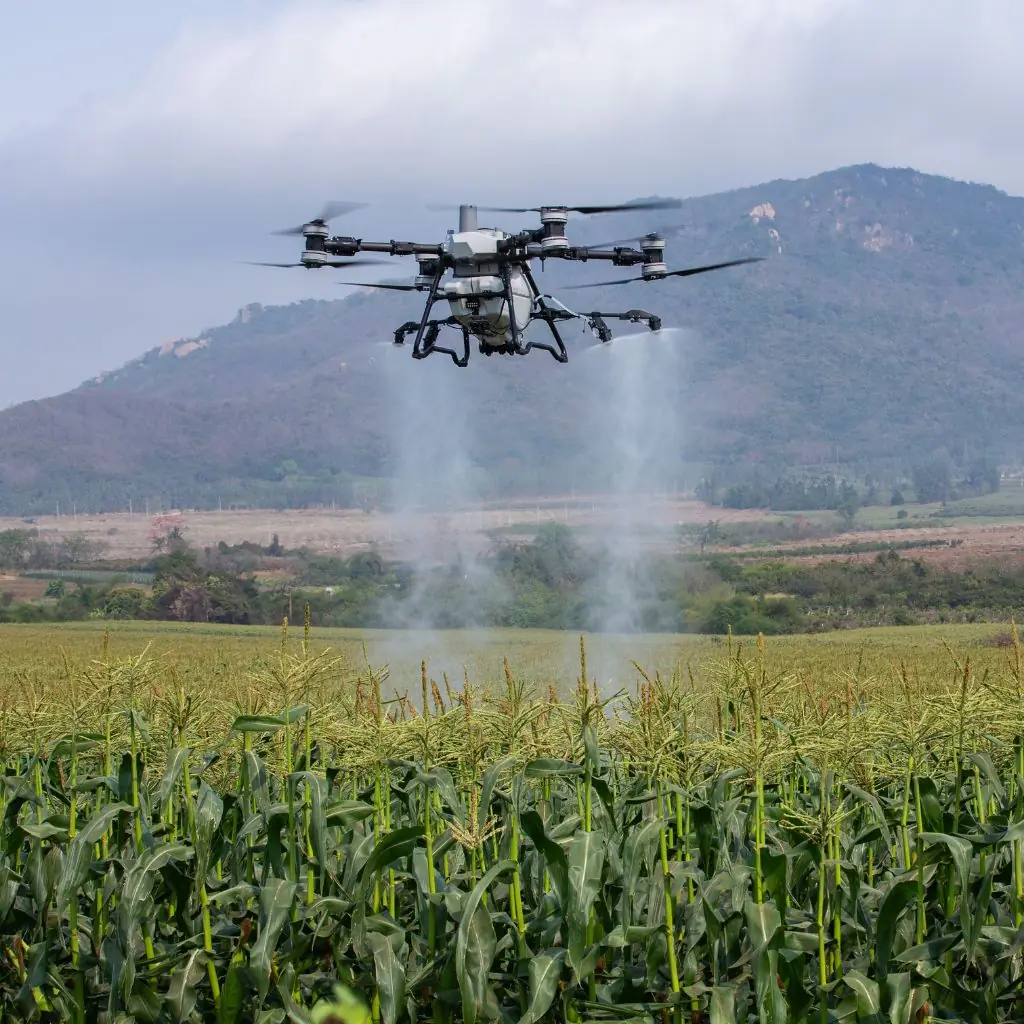
Drone fertilising means feeding and spreading without driving into the crop. It works where a tractor damages the plants or cannot get in: on wet fields, in tall maize, in canola, on slopes and on small, irregular plots.
What we can apply
- Liquid fertilisers – foliar feeding, micronutrients, biostimulants.
- Granular fertilisers – mineral and organic granules through the drone's spreader system.
- Seed – cover crops, grasses and intercrops. We sow seed by drone on short notice – SACAA RPAS aviation rules apply.
Why use a drone
- No tramlines or ruts – the whole crop stand stays intact.
- Timing – feed the crop at the critical growth stage, even when the field is impassable after rain.
- Even spread – RTK GPS flight along a planned route, with no overlaps.
- Variable rate – based on an NDVI map, when you want to fertilise by zone.
Which drone for which job
For spreading we use DJI Agras drones fitted with a spreader system: the lighter T25P for small fields and orchards, the T50/T55 as all-rounders, and the T70P and T100 for large areas. The choice depends on the application rate per hectare and the size of the field.
What it costs and how to order
Foliar fertiliser application and granular fertiliser spreading by drone are quoted in ZAR – price on request. Travel is quoted according to your location, and the client supplies the fertiliser.
- You tell us the crop, the fertiliser or seed, the rate and the area.
- We check the granule size and flow – not every granule spreads the same way.
- We plan the flight and timing, carry out the application, and you receive a report with a map.
FAQ – frequently asked questions
Can a drone spread any granular fertiliser?
Most standard granules, yes. Before application we check the granule size and calibrate the flow rate.
Can you fertilise by drone after rain?
Technically yes, because the drone doesn't drive onto the field. Aerial application must still comply with SACAA RPAS rules and, where relevant, the product label and Act 36 registration, and be done within safe wind and weather limits. We will check whether your field meets these conditions.
Can a drone fertilise by zone?
Yes, according to an NDVI map with a variable rate.